GoldmanSachs666 Message Board

Fraud*
According to the Collins English Dictionary 10th Edition fraud can be defined as: "deceit, trickery, sharp practice, or breach of confidence, perpetrated for profit or to gain some unfair or dishonest advantage".[1] In the broadest sense, a fraud is an intentional deception made for personal gain or to damage another individual; the related adjective is fraudulent. The specific legal definition varies by legal jurisdiction. Fraud is a crime, and also a civil law violation. Defrauding people or entities of money or valuables is a common purpose of fraud, but there have also been fraudulent "discoveries", e.g. in science, to gain prestige rather than immediate monetary gain
*As defined in Wikipedia

Wednesday, April 25, 2012

Goldman Sachs, Vampire Squids and Muppets

It's time to have a laugh and who better to have one against than Goldman Sachs.  So here is a protest against Goldman Sachs that is very relevant:
Muppets Protest at Goldman Sachs
By Joey Skaggs - Art of the Prank

Some early photos from yesterday’s demonstration at Goldman Sachs in New York to protest greed and corruption in the financial sector.

photo: Deborah Thomas
Event Summary:
A police van filled with officers parked across the street from our staging area and waited for us to depart. As we did, officers on foot walked with us, but across the street. When construction caused us to change our route, I approached an officer and asked the best way to go. From that point on, they functioned as a police escort. When we hit West Street, which is a highway with heavy traffic, the police van, with lights flashing, stopped the traffic for us. We entered the bicycle lane and it was a clear shot down to the Goldman Sachs office at 200 West Street. The police van, with flashing lights, accompanied us the entire way. They were amazingly coordinated, without every having talked with us.

The police presence grew as we approached Goldman Sachs. When we got there, there were at least 20 more officers, plus a full fleet of Goldman Sachs security guards lined up at the door. It was quite impressive. The fox is safe in the chicken coop. He has employed the uniformed chickens to protect him. I was personally greeted by the “hipster cop,” Community Affairs Detective Rick Lee.
Tactically, we kept moving and obeyed all the traffic and bicycle laws. We made a continuous loop in front of the building, with the muppets singing and dancing the Mobile Homeless Blues, an original song created for the event by the Fresh Juice Party band. Having made our point, we then marched through downtown Manhattan, visiting Zuccotti Park, Washington Square Park and Union Square. The reactions we encountered from people along the route, was encouraging and very touching.
As soon as we left Goldman Sachs, the police presence melted away. The police were only concerned with protecting the power center, the white collar criminals with blood on their hands, who have exploited the public. The bankers, who control the politicians, will continue to get away with their crimes against society until we, the people, make stronger demands. Let’s keep the pressure on. Fight for awareness and for change with creativity and humor.
photos: Joey Skaggs Archive
See the article here

Tuesday, April 24, 2012

⸮Poor Goldman Sachs--"frustrated and underappreciated"⸮

Dear Goldman Sachs, you may feel frustrated and underappreciated but I notice that you don't feel any of the pain that you caused people who are suffering under the new financial regime that you helped create through your unethical behavior. 

We sincerely wish that your bank be broken up into the smallest pieces possible; we hope that you will never again influence government policy; we will endeavor to regulate every single solitary derivative that you create; we have precious little sympathy for your not getting big salaries and bigger bonuses now; and we know that there are not many who will cry a tear for your demise. 

Your disappearance from the world stage is the right result especially since not one executive worldwide has had to go to jail for his malfeasance in bringing about the financial meltdown.  These small suggested acts mentioned above would be appreciated by us and would relieve some of our frustration.
Music Stops for Wall Street Bankers
By Anupreeta Das and Gina Chon - The Wall Street Journal

Bonuses have been cut for bankers of all levels, including junior bankers, whose pay many senior bank executives say is outsize given the new realities and how much business they bring in. Typically, analysts and associates who are at the bottom rung of the ladder earn base pay in the low six-figures, plus performance-based bonuses, according to industry participants.

The average managing director in investment banking makes around $400,000 in base pay, and high-performing bankers used to take home several million dollars in annual bonuses. But this year, Morgan Stanley generally capped cash bonuses at $125,000, while other banks put various restrictions on compensation.

Senior bankers say they are also being pushed to squeeze more revenue from clients, describing a world where maintaining long-term relationships with clients who only periodically reward a bank with business is no longer considered enough.

"There is a lot of soul searching going on among bankers," said one senior official at a large bank. "The squeeze on profits and the slow deals environment have made banking less fun and less fulfilling. People are asking themselves, 'is this worth it?"'
Read the whole story here

Monday, April 23, 2012

Goldman Sachs Employees Donate to Super Pacs

Rather than having a small foundation like Needmor Fund insisting on Goldman giving details about its lobbying activities, wouldn't it make more sense to legally require that all the lobbyists reveal whom they lobby, tell which political candidates they support via Super Pacs and reveal how much they spend on both?  The voting public would be greatly assisted in making better decisions when a full accounting of Goldman's money for lobbying and supporting campaign funds is made public, by law.

A non-binding proposal for disclosure by a foundation is not enough to serve the public good.
Goldman Sachs under pressure to reveal lobby ties
Should the bank name the groups it helps?  Investors to vote May 24
By Ronald D. Oral - MarketWatch

WASHINGTON (MarketWatch) — The Needmor Fund, a small foundation based in Toledo, Ohio, wants Goldman Sachs to lift the veil on its lobbying activities and the advocacy groups it backs financially. 

“Goldman Sachs has become a target for public criticism recently,” said Needmor executive director David Beckwith. “As owners we are concerned that the company uses its power and money in a responsible way as it seeks to influence public policy.” 

The fund, which has roughly $24 million in assets, has set up a shareholder vote at the company’s May 24 annual meeting on a nonbinding proposal calling on Goldman GS -1.16%  to reveal its lobbying activities — in detail. 

Dozens of other U.S. public corporations are, like Goldman, facing pressure from a variety of shareholder groups to shine a light on their lobbying work and bankrolling of political candidates.
But as a lightning rod for anger since the financial crisis, Goldman’s policies are ripe for heightened scrutiny in the debate. 

Earlier in April, the firm paid a $22 million penalty to settle Securities and Exchange Commission allegations that it didn’t have policies to prevent analysts from sharing nonpublic information with the firm’s traders. In March, Goldman was beset with a cause celebre over one of its executives who announced his resignation via a New York Times op-ed bemoaning the culture at the firm to be “as toxic and destructive” as he has ever known it.
SEC rules
All the while, Goldman has been a central player in the financial services industry’s response to the Dodd-Frank financial-oversight legislation.
Part of their lobbying focus is directed at government agencies like the Securities and Exchange Commission and bank regulators including the Federal Reserve while regulations are being written. Both, which are writing regulations based on the statute. 

Goldman also is lobbying lawmakers on energy, tax, banking and housing policy issues, according to congressional reports.
Read the full article here

Sunday, April 22, 2012

Goldman Sachs's Role in Financial Excess

Philip Pilkington interviews Thomas Palley regarding his book, From Financial Crisis to Stagnation.  Palley explains the economic ideas that contributed to the crisis of 2008 and mentions the role of the banks including Goldman Sachs.  Oil speculation by Goldman Sachs is also noted.

From Financial Crisis to Stagnation:  An Interview with Thomas Palley
By Philip Pilkington - Naked Capitalism

 . . . .
PP: In the book you provide a very clear description of what actually occurred in the financial market in 2008. Reading it I thought that a lot of people – myself included – have never really put the pieces together in their own minds. Maybe you could summarise the key events briefly?

TP: The mechanics of the crisis within the U.S. financial system are actually quite simple and can be understood as a six step process. Step one was the build-up of toxic loans over several years. Step two was when loans eventually started turning sour with the bursting of the house price bubble in 2007, causing loan losses. Step three was the destruction of bank equity caused by mounting loan losses. This process began in the so-called “shadow banking system” and then moved into the Wall Street investment banks and the established commercial banking sector. Step four was the resulting threat of bank defaults triggered by equity destruction. Step five was the rush to cash spurred by the threat of default. That caused a liquidation trap as agents tried to sell financial assets to raise cash, which deepened the extent of asset price declines and caused further equity losses. Step six was the run in the commercial paper market immediately after the collapse of Lehman brothers (September 2008) whereby banks and financial institutions became unwilling to lend to each other. That put every bank (including Goldman Sachs) on the verge of default, prompting the Federal Reserve to step in and de facto take over the commercial paper market by acting as lender of last resort.
PP: In the book you mention the commodities bubble that blew up in the 2008 financial crisis a number of times. Many commodities – oil included – are nearly back at their 2008 levels. Do you think that this could be due to speculation? If so, why on earth are the US government allowing this?

TP: I firmly believe speculation is a significant part of the run up in commodity prices, particularly oil. Over the last decade there has been tremendous change in the character of commodity market participants. In the past, the market consisted of producers, end-users, and traders intermediating between these groups. Now, the market has been invaded by financial investors in the form of pension funds, endowment managers, hedge funds acting on behalf of high net worth individuals, investment bank entities trading on their own account, and exchange traded funds (ETFs) for ordinary punters who want to speculate on commodities. This transformation represents the ‘financialization’ of commodity markets and it has resulted in a tsunami of money chasing commodities as a speculative investment vehicle. After causing a bubble and a bust in 2008, it has again pushed up oil prices.

The fingerprints of speculation are all over the oil market: large one day price spikes and plunges that cannot possibly be explained by changes in economic fundamentals; high prices in the face of large and growing inventories; storage in unconventional forms like idle super-tankers; and investment banks like Goldman Sachs purchasing oil storage capacity in places like Cushing, Oklahoma.
Read the rest of the interview here

Saturday, April 21, 2012

How Goldman Sachs Affects the Making of Financial Rules

On this blog we have been following the course of regulators who are creating new rules based on Dodd-Frank which are supposed to correct and help prevent another financial failure like the one of 2008.  However, it is taking a very long time to make the new rules and the banks have lobbied strenuously to alter or prevent rules that will reduce their profits.

Over-the-counter derivatives were part of the problem that brought about the Great Recession, but the banks are doing a stellar job of trying to change or delay rules that they do not like.  Even though the chairman of the CFTC, Gary Gensler, may be as honest as the day is long, he did work for Goldman Sachs and has members on his commission who have criticized the rule-making process at CFTC. 

The following article highlights some of the problems with making rules that regulate the financial system:

SEC, CFTC Retreat On Swap Dealer Regulation
By Mark Gongloff- HuffPost Business

Corporate America, with help from the Obama administration, has struck yet another blow against the scary financial regulations it claims will hurt the economy.

On Wednesday they undercut new regulations on derivatives, which the detail-obsessed among us might point out didn't just hurt the economy but nearly destroyed it. Just a few years ago.

It's just the latest in a growing string of defeats and surrenders by regulators to the same financial industry that helped nearly destroy the economy, and needed massive bailouts as a result. Just a few years ago.

Under heavy pressure from the energy industry and other corporate interests, the Commodity Futures Trading Commission and the Securities and Exchange Commission are retreating from a plan to regulate many reaches of the U.S. trade in financial derivatives known as swaps, including the credit derivatives that nearly brought down the financial system.

The CFTC and SEC voted on Wednesday to decide just who, exactly, should be considered a "swap dealer" in this market. Dealers will be subjected to greater regulation and oversight. Non-dealers get a pass.

Originally these regulators wanted to say that anybody who handled less than $100 million in swaps per year was not a dealer and thus would be exempt from regulatory oversight. This arbitrary number was far, far too low, cried energy companies and other players in the swaps market. After careful consideration, they thought another arbitrary number, say $3 billion, or maybe $8 billion, would be more reasonable.

These companies argued that they dealt in many billions of dollars in swap trades each year -- $3 billion to $8 billion, to be ridiculously precise -- just to hedge their risks of doing business. To subject their trades to the scrutiny of regulators would impose terrible costs that could very well hurt the economic recovery, for goodness' sake.
Read the whole article here 

Friday, April 20, 2012

Goldman Sachs and Obfuscation

Words can obfuscate or words can illuminate and sometimes words can do both at the same time. Take, for example, the words "fraud" and "corruption." As Yves Smith of Naked Capitalism points out here, the polite thing to do among groups of the elite is not to mention the words "corrupt" and "fraud" as these words would "alienate" those who corrupt and commit fraud.  Talking about ethics is a turn off especially for those who are ethically challenged.  She also mentions that there is always the argument that if corruption and fraud are mentioned, or worse pursued and investigated, then the whole system will fail.

An article in Bloomberg Businessweek shows how words obfuscate and illuminate at the same time.  Judge William Pauley III dismissed a case brought against Goldman Sachs's CDOs because there was not "sufficient fraud allegations" against Goldman:  Now this description may be the writer's misinterpretation of events in the courtroom but it still tells a certain truth.

Then there is this quotation regarding the same dismissal:
“The complaint in this case does not ascribe to Goldman or TCW any particular motive for committing fraud beyond a general profit motive common to all corporations, which does not suffice,” a three-judge panel of the appeals court in Manhattan said in an unsigned order. (By Bob Van Voris, Bloomberg Businessweek)
So we can conclude that 'fraud" exists in small increments--a little here and a little there and if there is not enough fraud then fraud does not exist. 

We could also conclude that as long as general profit is the motive for committing fraud, then there is no fraud.  But, come on now, profit (excessive profit and big honking bonuses) was THE motive.  How revealing are these writers and judges in spite of themselves!

Be not deceived --the system of justice and the system of finance themselves are corrupt and full of fraud that is being dismissed out of hand.
Sequoia Fund Manager Campaigns Against Goldman Board Member, Former Fannie CEO Jim Johnson
By Yves Smith - Naked Capitalism

A telling taboo in elite circles is the issue of corruption. At INET last year, after a panel discussion on the financial crisis, Jamie Galbraith said he was astonished that there was not a single mention of fraud. His observation was met with a resounding silence.

Similarly, I had a colleague tell me today that I shouldn’t use the “c” word, meaning corruption, since it would alienate potential allies. The logic is similar to arguments against being shrill. He claimed that even if a lot of people in positions of authority engage in corrupt looking behavior, that doesn’t mean they understand it to be corrupt, so calling the corrupt will merely get them worked up to no useful end. They could well think they are doing the right thing and just be victims of cognitive capture.

I deeply oppose this line of argument. First, it assumes that decision-makers don’t recognize when they are taking ethically problematic actions. The people I know who have yielded to institutional pressures to do the wrong thing say they knew they were doing so and found a way to rationalize it. And I suspect even sociopaths know where the lines are. They have to do a better job of covering their tracks when their conduct is dubious.

Second, it assumes that it isn’t worth taking a firm position on ethics because it will turn off powerful people who have engaged in questionable behavior. Better to be less accusatory in order to have a dialogue with them. I don’t buy that because being indulging their justifications of their conduct helps preserve a bad status quo.

One aspect of American exceptionalism is many still believe the US is cleaner and more above board than most other advanced economies. But if you go overseas, you will find that a lot of businessmen see the US as not particularly ethical. One British colleague who has worked with major US firms described the US as becoming more and more a scam-based economy (in fairness, he was really talking about the financial services industry). An American who works a great deal with foreign investors said his clients saw the US at best as on a par with other big countries, at worst, with Russia.

One of the big reasons for the erosion in US behavior is the notion that elite crimes shouldn’t be prosecuted because it would harm the system. Glenn Greenwald describes the pardon of Richard Nixon as a critical embodiment of this principle. And while people in influential positions have long been able to get away with all sorts of bad conduct, it’s one thing to have, say, speeding tickets disappear quietly (the hoi polloi are no wiser) and quite another to have a tax cheat oversee the IRS. In the old days, propriety and reputations mattered, and that served to check bad behavior.

So it is important to define norms and not shy away from words like “fraud” and “corruption” when they fit. While it would be nice if more people in power were capable of feeling guilt, shame will do. Thus naming and shaming are legitimate strategies for letting the elites know that the broader public is not fooled.
Read the whole article here 

Thursday, April 19, 2012

Goldman Sachs's Influence in Europe

From Ellen Brown's blog, Web of Debt:
The European Stabilization Mechanism, Or How the Goldman Vampire Squid Just Captured Europe
By Ellen Brown - Web of Debt

 he Goldman Sachs coup that failed in America has nearly succeeded in Europe—a permanent, irrevocable, unchallengeable bailout for the banks underwritten by the taxpayers. 


In September 2008, Henry Paulson, former CEO of Goldman Sachs, managed to extort a $700 billion bank bailout from Congress.  But to pull it off, he had to fall on his knees and threaten the collapse of the entire global financial system and the imposition of martial law; and the bailout was a one-time affair.  Paulson’s plea for a permanent bailout fund—the Troubled Asset Relief Program or TARP—was opposed by Congress and ultimately rejected.

By December 2011, European Central Bank president Mario Draghi, former vice president of Goldman Sachs Europe, was able to approve a 500 billion Euro bailout for European banks without asking anyone’s permission.  And in January 2012, a permanent rescue funding program called the European Stability Mechanism (ESM) was passed in the dead of night with barely even a mention in the press.  The ESM imposes an open-ended debt on EU member governments, putting taxpayers  on the hook for whatever the ESM’s Eurocrat overseers demand.

The bankers’ coup has triumphed in Europe seemingly without a fight.  The ESM is cheered by Eurozone governments, their creditors, and “the market” alike, because it means investors will keep buying sovereign debt.  All is sacrificed to the demands of the creditors, because where else can the money be had to float the crippling debts of the Eurozone governments?

There is another alternative to debt slavery to the banks.  But first, a closer look at the nefarious underbelly of the ESM and Goldman’s silent takeover of the ECB . . . .

. . . .

Goldman Sachs and the financial technocrats have taken over the European ship.  Democracy has gone out the window, all in the name of keeping the central bank independent from the “abuses” of government.  Yet the government is the people—or it should be.  A democratically elected government represents the people.  Europeans are being hoodwinked into relinquishing their cherished democracy to a rogue band of financial pirates, and the rest of the world is not far behind.

Rather than ratifying the draconian ESM treaty, Europeans would be better advised to reverse article 123 of the Lisbon treaty.  Then the ECB could issue credit directly to its member governments.  Alternatively, Eurozone governments could re-establish their economic sovereignty by reviving their publicly-owned central banks and using them to issue the credit of the nation for the benefit of the nation, effectively interest-free.  This is not a new idea but has been used historically to very good effect, e.g. in Australia through the Commonwealth Bank of Australia and in Canada through the Bank of Canada.

Today the issuance of money and credit has become the private right of vampire rentiers, who are using it to squeeze the lifeblood out of economies.  This right needs to be returned to sovereign governments.  Credit should be a public utility, dispensed and managed for the benefit of the people.

To add your signature to a letter to parliamentarians blocking ratification of the ESM, click here. 
Read the entire article here

Wednesday, April 18, 2012

Goldman Sachs and "Money, Power and Wall Street"

Here is a PBS documentary worth seeing about the Financial Crisis brought to us by Wall Street including Goldman Sachs:
Money, Power and Wall Street|PBS Frontline Four-Hour Investigation Goes Inside the Epic Story of the Global Financial Crisis
Posted on 4closureFraud

Tuesdays, April 24 and May 1, 2012, from 9 to 11 P.M. ET on PBS

Since 2008, Wall Street and Washington have fought against the tide of the fiercest financial crisis since the Great Depression. Now, FRONTLINE’s veteran financial and political producers Martin Smith (College Inc., The Madoff Affair) and Michael Kirk (Inside the Meltdown, The Warning), team up to present the inside story of the struggles to rescue and repair a shattered economy, exploring key decisions, missed opportunities and the unprecedented and uneasy partnership between government leaders and titans of finance in Money, Power and Wall Street, a four-hour investigation airing Tuesdays, April 24 and May 1, 2012, from 9 to 11 P.M. ET on PBS (check local listings).

The revolution in modern finance began not in a Wall Street boardroom but at a luxury hotel in Boca Raton, Fla. There, in the summer of 1994, a team of 20-something bankers from JPMorgan pioneered an insurance product for loans called a credit default swap. “The defining problem was that banks were unable to adequately deal with their own credit risks,” says Bill Winters, the former co-CEO of JPMorgan’s investment bank. With the credit default swap, JPMorgan created a new marketplace in which banks could buy and sell risk. It fueled a golden era of profits for the banking industry and a boom in global investing.
Read the rest of the information and see the video here

Tuesday, April 17, 2012

A Reminder of the Influence of Goldman Sachs

It's time to remind everyone how Goldman Sachs influences the policies of government:
Goldman Sachs:  Investing in political influence
By David Gutierrez - infowars

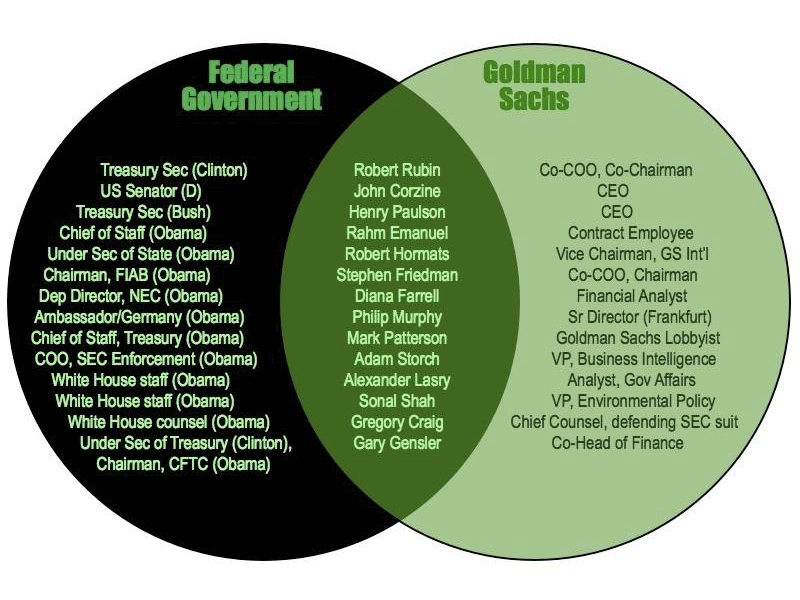
(NaturalNews) A Venn diagram released by Harvard law professor and political activist Larry Lessig reveals the shocking connections between our government and banking and investment giant Goldman Sachs.

Click for full image.


Goldman Sachs was a major contributor to (and beneficiary of) the 2007 subprime mortgage crisis that helped initiate the current depression. The bank then proceeded to heavily avail itself of bailout payments and other monetary assistance from the federal government.

In 2010, the Securities and Exchange Commission (SEC) filed a lawsuit against the company, alleging that it had deceived investors about the nature of one of its products, costing them a total of $1 billion.
Goldman Sachs was defended in the lawsuit by its longtime legal firm, Skadden, Arps, Slate, Meagher & Flom, LLP. One of its advisors on defense strategy was a partner in the firm by the name of Gregory Craig, who had left his job as White House Counsel only months before. When observers raised ethical concerns, some of them pointing out that the Obama Administration prohibits its former members from lobbying it for at least two years, Craig responded by saying, “I am a lawyer, not a lobbyist.”
Read the entire piece here 

Monday, April 16, 2012

Goldman Sachs Jams Its "Blood Funnel" into Canadian Films

Canada's intrepid film makers have created a large collection of films that represent Canadian points of view and Canadian cultural values.  When Goldman Sachs decides to sell Canadian films without the Canadian producer's permission or without recompense, then that is not on.

Robert Lantos is suing over the sale of six of his films by Goldman Sachs Investment Partners.  These films are important to Canada's cultural heritage as they reflect Canadians to themselves in a sea of Hollywood productions that crowd theaters in Canada where it is very unusual to see a Canadian production. Canadians are not (yet) interchangeable with Americans and we have our own stories to tell. 

Goldman doesn't give a plugged nickel about our stories so they should not have any say as to where these Canadian film rights should go.
Producer Lantos sues Goldman over sale of film rights
By Gayle MacDonald and Simon Houpt - The Globe and Mail

Robert Lantos, the canny, creative, and famously combative movie producer who once stood atop the Canadian film and television business as the chairman and CEO of Alliance Communications, has filed suit in a bitter custody dispute over six of his films which he says were sold to an international distributor without his permission.

In a statement of claim filed with Ontario’s Superior Court of Justice last month, Mr. Lantos alleges the new owners of Alliance Films, namely Goldman Sachs Investment Partners, the private equity arm of the U.S. investment bank, acted improperly when it sold off the international distribution rights to the films to Alliance Atlantis International in 2007. The following year, Alliance Atlantis International re-sold the rights as part of a 7,500-title deal to Echo Bridge Entertainment, a little-known home entertainment distributor based in Needham, Mass.

The films include critically acclaimed features such as Sunshine and Atom Egoyan's Ararat, which won Genie Awards for best picture, and David Cronenberg’s eXistenZ. The other three are Picture Claire, Denys Arcand’s Stardom and the Paul Gross comedy Men With Brooms.

The 63-year-old is seeking unspecified damages and residual fees from these films in a suit that also names Echo Bridge and Alliance Atlantis International Distribution Ltd. as defendants.

Ironically, Mr. Lantos’s beef is not with Alliance Films, whose chair is his long-time business partner and flamboyant friend, Victor Loewy. He had to list Alliance Films in the suit because his contract, technically, is with them.

“It pains me to have to sue the company I founded and spent 25 years building,” said Mr. Lantos, who produced the Oscar-nominated Being Julia (starring Annette Bening) and Barney’s Version. “But its current owner Goldman Sachs has disposed of the international rights to my films, without having the right to do so, and without paying me.
Read the entire article here 

Sunday, April 15, 2012

In 2011, Did Goldman Sachs's Blankfein Get Paid $12.4 million or $16.2 million?

What a slippery vampire squid he is!  Not many people can claim both a pay increase and a pay decrease in the same year.

What is interesting, though, is that Blankfein spent $258,700 on security because of those pesky Occupiers.  That's probably a good price to pay for a conscience that knows no guilt.

Does any bank executive deserve 240 times more money than the average American ($50,000)?  Not when you consider that Blankfein played a key role in bringing about the financial crisis that affected the whole world economy.  Not when you consider the many communities that have been devastated by sub-prime mortgages that Goldman couldn't get enough of.  Not when you consider all the wealth that was transferred from pensions and savings to Goldman.  Not when you consider that all the fraud of the big banks did not result in one executive being prosecuted.
Goldman CEO Blankfein's 2011 Compensation Jumps to $16M
By Reuters

Goldman Sachs Group Inc Chief Executive Lloyd Blankfein's compensation increased 14.5 percent to $16.2 million in 2011 despite a sharp decline in profits and share price during the year, leaving the bank open to more attacks on its pay policies.

Blankfein's pay boost includes stock awards from previous years that vested in 2011, and therefore does not reflect the amount that Goldman's board awarded him strictly for the company's performance last year.

Goldman offered another figure, $12 million, as the amount Blankfein received for his performance last year. That number reflects a 35.5 percent decline from 2010, when Blankfein received $18.6 million in performance pay.

The $16.2 million figure comes from a formula the U.S. Securities and Exchange Commission requires companies to use when reporting pay packages in proxy filings, where Goldman detailed Blankfein's compensation on Friday.

Both the SEC's formula and Goldman's formula include a $2 million salary and a $3 million cash bonus. The SEC formula also reflects $454,332 Blankfein received last year in benefits and perks, such as life insurance, and a car and driver.
Read the entire article here

Saturday, April 14, 2012

Whether Goldman Sachs Pays $22 or $22 million--It Is All the Same to Them and Means Nothing!

"Huddles"--such a cute little euphemism for fraud and insider trading.  There must be thousands of such words that have been used to describe Goldman Sachs activity, activity that really describes fraud.  Not only that, but banks found guilty in civil cases do not have to admit to any guilt whereas in criminal cases they do.  Such fine distinctions hardly matter when the activity is really fraud and the price paid for fraud is an insignificant fine.  All the money made because of the fraud should have been included in the fine.

Sharing confidential information within a company about clients is surely a form of insider trading.  But somehow Goldman Sachs doesn't pay the penalty of a Rajat Gupta, for instance.  We need a definition of fraud that excludes the words now used to describe Goldman activity like huddling, tipping clients, fleecing, spinning, violating, taking risks, sharing asymmetrical information, etc.

Such useless euphemisms now serve to define the justice system and make a mockery of justice and government power.

The words we want to see are subpoenas, indictments, prosecutions and jail time for fraud and felony committed by Goldman Sachs. 

You can read the Administrative Proceeding here and the SEC memo regarding Goldman Sachs's latest fraud here.

Richard (RJ) Eskow tells it best at HuffPost Business:

The Latest SEC/Goldman Sachs Sweetheart Deal Is the Worst One Yet
By Richard (RJ) Eskow - HuffPost Business

The sweetheart deals just keep coming. Lawbreakers at one bank after another are let off the hook as their shareholders write a check. And then they go out and repeat the illegal behavior they promised not to do in the last settlement.

It shouldn't be surprising that this keeps happening over at the SEC -- especially as long as Robert Khuzami continues to serve as Director of the Commission's Division of Enforcement.

But while each of these deals has been shameful, destructive, and outrageous, the $22 million agreement with Goldman Sachs which the SEC announced today -- another one in which the guilty party "neither confirms nor denies wrongdoing" -- looks like the worst one yet.

The SEC has the power to shut Goldman Sachs down for what it did, and the offenses it describes are felonies. But they just gave out another slap on the wrist -- no, make that a pat on the wrist -- with today's announcement.

The Worst Thing
It's not just the fact that the SEC continues to ignore the public's outrage by letting bankers off scot-free. And it's not just that this kind of irresponsible behavior ensures that the lawbreaking will continue. Its not just that crooked bank executives are allowed to "neither admit nor deny wrongdoing."

It's not even the fact that this time around the SEC has worded its announcement in a clumsy attempt to obscure the criminal behavior of Goldman's employees -- although that's one of this agreement's worst features.
Read the complete article here 

Friday, April 13, 2012

Goldman Sachs Takes Reno

Reno alleges that Goldman Sachs committed fraud when it was persuaded by Goldman to issue $210 million in bonds that were supposed to be safe.  Reno is asking FINRA to arbitrate "to recover the damages it sustained due to Goldman's misrepresentations and omissions."

The auction rate securities sold to Reno had a higher risk than the bank disclosed.  Reno is left with extra fees and interest payments when they refinanced through Goldman.  The article explains here how auction rate securities worked with the help of the banks.  Reno could face default if an agreement cannot be made with Goldman Sachs.

Conclusion:  No city should want to use Goldman Sachs as its bank of choice.
Reno takes on Goldman Sachs
City alleges bank misrepresented risk
By Brian Duggan - RGJ.com

 Reno is suing Goldman Sachs, alleging fraud against one of Wall Street’s largest investment firms.
The city claims Goldman persuaded Reno to issue $210 million in bonds in a specialized market that the bank claimed was safe even though it knew it could turn toxic.

Reno is seeking arbitration against the bank through the Financial Industry Regulatory Authority, basically a private court for financial institutions.

Reno seeks “to recover the damages it sustained due to Goldman’s misrepresentations and omissions” when the city issued the bonds on the so-called “auction rate securities” market in 2005 and 2006 for its downtown events center and railroad trench projects, according to complaint filed in February.
Goldman Sachs declined to comment for this article.

The saga over auction rate securities is just one of many financial crises Reno currently faces. This includes distressed redevelopment debt that’s teetering on default and falling revenues that have forced it to cut city staff, including firefighters and police, by about a third since 2009.

Joe Peiffer, an attorney with the New Orleans-based law firm Fishman Haygood Phelps that was hired in December to represent Reno, said Wednesday those damages could total into the “multiple millions” of dollars.
Read the entire article here 

Thursday, April 12, 2012

Goldman Sachs and Litton Loan Servicing--Again!

We have been following Goldman Sachs and its relationship with Litton Loan Servicing which was purchased by Goldman in 2007 and sold in 2011.  Here are some excerpts from our postings:
Goldman Sachs's opportunistic moves do not always pan out. Take Litton Loan Servicing which Goldman bought in 2007 when it was trying to obtain as many sub-prime mortgages as it could in order to concoct those CDOs that it foisted on unsuspecting buyers before the financial meltdown in 2008. Goldman Sachs is now considering selling this company.

I do not wonder why they are selling it: Litton serviced $9.7 billion in mortgages and had a delinquency rate of 43% in 2009. Goldman Sachs halted 23,000 foreclosures in order "to sort out affidavits that were signed without a review of the documentation."

Goldman Sachs's actions surrounding Litton lie at the heart of the fraud that Goldman Sachs perpetrated, not only on the homeowners of the US but also on the pensions and savings funds that bought the highly rated CDOs that Goldman Sachs touted.

Goldman Sachs had to buy a less-than-sterling company in the hopes of keeping its CDOs rolling along and raking in the money but Litton proved to be a horror show for hundreds of the homeowners who were caught in its snare. Customers who were unfortunate enough to buy their mortgages through Litton have a great deal to complain about. See the hundreds of complaints against Litton listed here.  (From Wednesday, March 16, 2011, post here)

 And then there is the Litton Loan Servicing unit which Goldman Sachs would very much like to sell and about which we posted information earlier here. There are hundreds of complaints by Litton customers which you can read about here. Since we first linked with the complaints page, there have been even more complaints accruing! No wonder Goldman Sachs would like to unload this tarnished little gem!

You can read about Litton here and here.  (From Thursday, May 26, 2011, post here)

Goldman Sachs has also disgorged itself of Litton Loan Servicing. You can find some background information on Litton Loan Servicing here and here. As Goldman Sachs itself admits, it does not deal well with retail business. There are many dissatisfied Litton homeowners whose complaints have yet to be heard and dealt with.  (From Friday, June 10, 2011, post here)

Lack of empathy characterizes those who greedily obtain wealth by taking advantage of others. Goldman Sachs had a big appetite for obtaining subprime mortgages in order to securitize them and sell them to investors and at the same time bet against the mortgage market to make humungous amounts of money when the mortgage market failed. They helped the market fail and made money off that failure!

Goldman Sachs conveniently places itself outside the world described above as they managed to get rid of their loans before the meltdown occurred, but they still participated in actions that made foreclosures a certainly and urban blight a consequence. Read the memorandum from Levin and Coburn of the Senate Permanent Subcommittee on Investigations, Exhibit #1a page 5 on [after intro page 17]. There are two examples there of Goldman Sachs as "an active participant in the mortgage market, particularly in the area of securitization."

Janet Tavakoli illustrates the problems that evolved from foreclosures and securitization, including the death of communities, because of the actions of banks like Goldman Sachs and servicing companies like Litton Loan Servicing which GS once owned.  (From Tuesday, June 28, 2011, post here)

When Goldman Sachs objected to Bank of America's proposed $8.5 billion settlement with investors (including Goldman Sachs subsidiaries!) because it claimed it lacked information, it seemed rather puzzling. Surely Goldman Sachs would jump at a chance to get rid of its MBS liabilities and fraudulent behavior in packaging up sub-prime mortgages, having them highly rated and then selling them to unwary investors before they turned to junk but not before GS earned huge fees and won big hedging bets as the mortgage market failed.

Well, Goldman Sachs is no slouch!

GS has negotiated its own way out of being accused of criminal and fraudulent behavior: it has negotiated its own little deal with a New York regulator, Benjamin M. Lawsky.

The background story about Litton Servicing has been dealt with on our blog here, here and here.

Which is more corrupting--having Goldman Sachs make a settlement deal with lots of promises to be good or having a regulator letting Goldman Sachs off the hook for fraudulent practices? Take your pick: it's both those things.

This action is not "cleaning up some of its most controversial practices." Nothing is clean here; instead, it is very dirty, filthy and foul.

Settling with Goldman Sachs is papering over fraud committed by Goldman Sachs and adds to the corruption of justice in the United States. Shame!  (From Thursday, September 1, 2011, post here)

Goldman Sachs had to make a few promises to the New York Banking Regulator and to the Federal Reserve. Goldman promises to not misbehave so that it can sell Litton Servicing (at a loss). GS is accused of "misconduct and negligence" which is clearly a euphemism for "fraud." Commentators use the words "wrist-slap" and "reprimand" for the actions of regulators and that clearly is the punishment meted out for fraud.

Euphemistic descriptors that do not instill confidence in justice ever being brought to bear on Goldman Sachs will become commonplace because regulators prefer not to use "fraud" or "illegal." Why is that? Instead we have "formal enforcement action" by the Federal Reserve. When someone has done a dastardly deed and you make a "formal enforcement action" against him, it must be a joke, right?

Goldman has to pay penalties (money), answer to civil claims, bring in a consultant to review foreclosures, write down mortgage loan principals to the tune of $53 million (more petty cash), and, apparently, be good in the future. It appears that GS can pay its way out of trouble.

These actions are merely interesting but they do not represent justice for the people who were defrauded out of their pensions, their savings and their home ownership by Goldman Sachs's fraudulent securities. It certainly doesn't seem a proper response to those who brought us this nice recession.  (From Friday, September 2, 2011 post here)

After reading the DSNews article written by Krista Franks called "NY Approves Goldman Sach's Sale of Litton with Stipulations," we ask, What kind of message is sent to Goldman Sachs when the New York Department of Financial Services and Banking Department "stipulates" good behavior with only the threat of monetary penalties? Maybe no message at all!

Goldman Sachs does not act with ethics or conscience when it comes to making a deal for money. Paying a fine is small potatoes when the firm sets aside $3.4 billion as its cost of doing business. The $53 million principal reduction on Litton mortgages is just as small. How was such an amount arrived at? Were all the mortgages evaluated?

The "illegal" practice of robo-signing is a fraud and should be treated as a criminal charge. HAMP appears to lessen Goldman Sachs's culpability. Shouldn't GS strive for the "highest" standard rather than just a "new higher standard." It's all hogwash.

The best sentence of all in the article, the one that made me spew my coffee all over my keyboard was the utterance by Lawsky:

“Goldman Sachs, Ocwen and Litton have now all agreed to put the rights of homeowners ahead of their profit margins by implementing these changes.”

When Pigs Fly!

The Federal Reserve Board (where was IT during the 2006-2008 years?) comes forth mouthing platitudes too. GS has "requirements" to live up to also. Where are the words "FRAUD" and "CRIMINAL BEHAVIOR?" When GS didn't behave ethically (and they didn't), they should be charged and judged by the Justice department.

Banks shouldn't just "consent to enforcement requirements." They should be compelled and ordered to follow the rules laid down in the regulations and pay penalties including jail time when these are not adhered to.

How cozy are banks to regulators and the Federal Reserve! Just follow the Goldman Sachs guys who are now in government and in regulatory positions. It is no wonder that Goldman Sachs has no credibility.  (From Tuesday, September 6, 2011 post here)

Now we have some more information about Litton from ProPublica that tells about Chris Wyatt, a former employee of Litton Loan Servicing when it was a Goldman Sachs subsidiary.  The shoddy practices that he describes tells the other part of the story about how wonderful a bank Goldman is!
Excerpt:  At Goldman Sachs Servicer, 'Total Disaster'
By Paul Kiel - ProPublica

As of the end of 2010, fewer than 12 percent of the borrowers who'd applied for a HAMP modification with Litton were granted one. The vast majority of those denials, Wyatt says, were not legitimate. Goldman Sachs' emphasis on maximizing profits rather than preventing foreclosures is typical of the servicing industry, he says, particularly the larger banks. 
Read the entire article here and the longer history of foreclosure here

Wednesday, April 11, 2012

Goldman Sachs and Democracy Are At Cross-Purposes

Goldman Sachs International (GSF) was fined £25,000 by ICE Futures Europe for a "breach of the Exchange Regulations concerning disorderly trading."  So it continues:  Goldman breaks the rules (and makes a lot of money doing so), acts unethically, pays a small fine and goes on its way.  Breaching regulations sounds like fraud to me.

Stephen Lendman makes some important observations regarding Goldman Sachs in the linked article below:

Goldman Sachs:  Making Money By Stealing It
By Stephen Lendman - Mathaba

Money power in private hands and democracy can't co-exist. Wall Street crooks transformed America into an unprecedented money making racket.

Goldman symbolizes master of the universe manipulative fraud. It's been involved in nearly all financial scandals since the 19th century.

It makes money the old-fashioned way. It steals it through fraud, grand theft, market manipulation, front-running them, scamming investors, bribing political Washington, having its executives in top administration posts, and getting open-ended low or no interest rate bailouts when needed.

It's business model and culture assure billions of bonus dollars for company officials, complicit traders, and others on the take. It's a crime family, not a bank. It's connected to others like it on Wall Street and corrupt politicians.

Compared to Goldman, Bernie Madoff was small-time. So are most other swindlers. Ones who matter most sit in Wall Street board rooms, plotting other scams.

Former bank regulator expert on white-collar crime, public finance, economics, and related law, Bill Black explained Goldman shenanigans pertaining to earlier SEC charges this way:

"Goldman designed a rigged trifecta. It turned a massive loss into a material profit by selling deeply underwater, toxic CDOs it owned. It helped make John Paulson (CEO of a huge hedge fund that Goldman would love to have as an ally) a massive profit - in a 'profession' where reciprocal favors are key, and blew up its customers that purchased the CDOs."

An SEC civil suit charged Goldman with defrauding customers. It made billions, and settled for $550 million. It was pocket change, the equivalent of four 2009 revenue days. It hardly mattered.

No executive was fined or imprisoned. Grand theft continues unabated. They include fraudulent pump-and-dump schemes. Major media scoundrels don't explain. Only scammed customers and insiders part of the dirty game understand.

On March 4, Black used James Q. Wilson's "broken windows" metaphor pertaining to blue collar crime. He applied it to far more serious elite white-collar offenses. None rise to the level of financial ones. The amounts involved are staggering. Broken lives, communities, and economies result. The landscape's littered with them.

Read the rest of the article here 

Tuesday, April 10, 2012

Goldman Sachs and the Volcker Rule

Bill Moyers interviewed Paul Volcker on April 5, 2012, about the implementation of the Volcker Rule which attempts to stop speculative trading by banks like Goldman Sachs.  Volcker explains how the Rule would discourage banks, which now get government support, from taking risky and destructive bets.

Gambling With Your Money 
Interview of Paul Volcker by Bill Moyers 

BILL MOYERS: Welcome. Well here we go again. The old game of congressional creep. After months of haggling and debate, Congress finally passes reform legislation to fix a serious rupture in the body politic. The president signs it into law, but then we discover the fight’s just begun, because the special interests immediately set out to win back what they lost when the reform became law. They spread money like manure on the campaign trails of key members of Congress. They unleash hordes of lobbyists on Capitol Hill, cozy up to columnists and editorial writers, spend millions on lawyers who try to rewrite or water down the regulations required for enforcement. And before you know it, what once was an attempt at genuine reform creeps back towards business as usual.

It’s happening right now with the Dodd-Frank Wall Street reform and Consumer Protection Act -- passed two years ago in the wake of our disastrous financial meltdown. Especially vulnerable is a key provision of Dodd-Frank known as the Volcker rule -- an attempt to keep the banks in which you deposit your money from gambling your savings on the bank’s own, sometimes very risky investments. It will come as no surprise that the financial industry hates the Volcker rule and is fighting back hard.

Just look at these headlines:

“Bank Lobby’s Onslaught Shifts Debate on Volcker Rule.” “Big Banks are Winning on Volcker.” “Lawmakers Pushing for Weaker Volcker Rule Reap Wall Street Cash.” “Banks Act to Skirt Volcker Rule on High-Risk Trades.” 

You can read the transcript and see the video here

Monday, April 9, 2012

Goldman Sachs and Oil Speculation

Merrill Goozner of The Fiscal Times discusses the role of speculation, by Goldman Sachs and others, in making the price of gasoline higher.  Legislation against market speculation may control the oil futures markets.
High Gas Prices?  Blame Goldman Sachs
By Merrill Goozner - The Fiscal Times

Democrats in Congress are preparing a volley against oil market speculators in their effort to counter charges by Republican frontrunner Mitt Romney that the Obama administration’s energy policies are to blame for skyrocketing gasoline prices.

A coalition of consumer groups, petroleum marketers and some industrial users said Thursday that legislation will be introduced in the House and Senate in the next few weeks that would slap new controls on oil futures markets. The goal is to curb the speculation that they say is driving up oil and gasoline prices and threatening to derail the economic recovery.

According to Mark Cooper, the chief economist of the Consumer Federation of America, and University of Maryland law professor Michael Greenberger, who in the late 1990s oversaw derivatives trading at the Commodity Futures Trading Commission, the proposed law would stop investment banks like Goldman Sachs and Morgan Stanley from selling oil-based commodity index funds; order an immediate Justice Department probe into oil speculation; and add 400 oversight staff to the CFTC to police oil and other futures markets.

“The American consumer is paying 75 cents more per gallon because of excessive speculation,” said Cooper. “That’s eating a hole in consumers’ pocketbooks and the U.S. economy.”
Read the article here 

Sunday, April 8, 2012

Goldman Sachs and Wealth Transfer Strategies

Goldman Sachs has managed to direct and control the wealth of the United States for its own purposes.  Goldman Sachs is, and has been over time, influential in setting monetary policy in the NY Fed (William C. Dudley), in the Treasury (Hank Paulson) and in regulatory agencies (Gary Gensler).  Indeed, as James Galbraith says,  "[t]he financial sector controls those parts of the government that set policy for finance."  Goldman has also used campaign contributions for elected officials that influenced financial policy.

Galbraith also sets forth his ideas on breaking the hold that finance has on the government. 

Finance as Wealth Transfer mechanism:  An Interview with James Galbraith
Interviewed by Philip Pilkington - Naked Capitalism

In the United States, the government has the power to bring the financial sector under control. It should use that power. Our problem is that the financial sector controls those parts of the government that set policy for finance. The banks are leading funders for presidential campaigns. The leading personnel in the Treasury and other financial agencies come from the banks, and if they do a good job (from the banks’ point of view), they can be confident that a lucrative sinecure awaits them, back at the banks, later on. This provides a very strong disciplinary effect on their conduct in office.

So – where to start? I’d *start* by breaking that link between the banking sector and the public sector.
One practical way would be to create a truly independent, effective and well-financed financial crimes enforcement unit, beyond the control of the political appointees at the Department of Justice, Treasury and the captive regulatory agencies. Also restore mark-to-market accounting and place the full control of audits and stress tests in hands that do not have an obvious conflict of interest viz. the results.
 
PP: People in the US – especially due to the Occupy movement – are becoming increasingly concerned about campaign financing by, among other groups, the banks. This seems to be the tie between the two sectors that ensures nothing gets done about Big Finance. I understand that you’ve spent some time around policy circles and the like. Maybe you could say something about this, the effect it has on regulation and policymaking and the potential to do something about it?

JG: I was on the staff of the House Banking Committee in the second half of the 1970s. At that time, the Committee hearing room in the Rayburn Building had just two rows of desks for members. Today there are four rows, and barely space for a table of witnesses, let alone anyone else. In other words, the size of the Committee has about doubled.

Why is this? Because the leadership in the House uses that committee as a fund-raising magnet, especially for Members who might be a little bit vulnerable. Once a Member has a spot on the banking committee, money problems go away. And one can hold practically any position on other issues that may be convenient — liberal, conservative, the banks don’t care. All you have to do is be friendly to bankers.

This is a formula for locking down the Congress. As I said, with the executive branch, it’s a bit different; while campaign financing is a significant question, so too is the actual staffing of the government, which is controlled by bankers; people come in from the banks and go back to the banks. It’s not a secret, for instance, that Robert Rubin’s protégés took a very large share of the top policy positions on economics and finance in the Obama administration — from Larry Summers on down. It’s not a secret that Peter Orszag, the first director of OMB under Obama, took a well-paid position at Citigroup on leaving the White House.

I have no simple formula for dealing with this, beyond what I keep repeating: 1) enforce the laws against financial fraud and 2) downsize the financial sector as a matter of public policy.
Read the entire interview here 

Saturday, April 7, 2012

A Goldman Sachs Deal That Is Usurious

Oakland City is trying to negotiate a better deal with Goldman Sachs.  Goldman does not care about building up the community as it has set its eyes on attaining the prize, i.e., making money.

Kaplan, community members discuss city's bond debt deal with Goldman Sachs
By Ryan Phillips - OaklandNorth

. . . .

In 1997, Oakland and the investment bank Goldman Sachs agreed to a rate-swap deal relating to $187 million in city debt. The deal allowed the city to convert floating interest rates on the debt into a fixed rate of 5.6 percent. But what appeared to be a good deal at the time has proved costly in the long run, after the market collapsed in 2008 and interest rates dropped to below 2 percent. The city has come out on the short end of the deal, and has already paid out $26 million more than it owed and is currently paying $5 million annually.

The deal has upset many in the city because when the market crashed in 2008, big banks like Goldman Sachs were bailed out with billions in taxpayer money, but now that Oakland is in dire financial straights, the bank hasn’t agreed to renegotiate the terms of the deal to give the city some relief. As a result, Kaplan said, there is “less money for public services” because money is being paid towards Goldman Sachs.

“As it says in Leviticus, chapter 25, verse 6, ‘If your kinsman being in straights comes under your authority, let him live by your side. Do not extract from him usery through interest,” Kaplan said to a group of about 75 people sitting in folding chairs in an auditorium at the church.

“Do not lend upon usery,” Kaplan continued, to calls of “Yeah!” from the crowd. “Do not lend upon usery. That means do not charge unjust interest. ‘Do not charge unjust interest’ is in here 4,000 years ago. People were worrying about unjust interest and it is still an issue today.”

Kaplan has called the deal a “toxic asset” for the city, and last June, wrote a letter to Goldman Sachs CEO Lloyd Blankfein asking to renegotiate the deal because companies like Goldman Sachs have a responsibility to “operate in a manner that would be beneficial to the public” after using “taxpayer dollars in order to salvage private, for-profit corporations.”

Read the entire article here

Friday, April 6, 2012

Goldman Sachs May Be "Home Free" Again!

When the Rule of Law is ignored and when forgery and other frauds become a reason to impose a fine on a company as though it had merely parked in the wrong zone, then we have very unhappy and frustrated citizens.  And so it is that Goldman Sachs may just have to pay a fine rather than answer for fraud and forgery it committed if the administration and the states' Attorneys General have their way.

What does Goldman Sachs learn from being fined for forgery and other abuses performed during foreclosures?  It learns to keep just enough money on hand to pay for a few millions of dollars in fines for breaking the rules and for forging documents.

This recommendation cannot make the foreclosed homeowners feel safe.  Goldman would hardly seem "pushed" to agree to such a mortgage settlement as it is a "get out of jail free" card for forgery that is euphemistically called "robo-signing."

Since when does fraud get called "unsafe and unsound practice?"  The pass for Goldman Sachs and seven other firms comes from deep within the Federal Reserve--from the Division of Consumer and Community Affairs which recommends this way of treating fraud.

In return for its fine, all Goldman will have to do is promise not to be bad again, and again, and again, and again--ad infinitum.  That will teach Goldman to behave!

And who represents the lonely foreclosed upon homeowner when the AGs and the government make deals with banks that commit fraud?

Fed may fine firms not part of foreclosure deal
By Jessica Silver-Greenberg - The New York Times

Federal regulators are poised to crack down on eight financial firms that are not part of the recent government settlement over home foreclosure practices involving sloppy, inaccurate or forged documents. 

Last week, a senior Federal Reserve official recommended fines for these additional financial institutions, raising questions about how deep foreclosure problems run through the banking industry.

In addition, judges, lawyers and advocates for homeowners say that people are still losing their homes despite improper documentation and other flaws in the foreclosure process often involving these firms.

The eight firms cited by the Federal Reserve — HSBC’s United States bank division, SunTrust Bank, MetLife, U.S. Bancorp, PNC Financial Services, EverBank, OneWest and Goldman Sachs — should be fined for “unsafe and unsound practices in their loan servicing and foreclosure processing,” Suzanne G. Killian, a senior associate director of the Federal Reserve’s Division of Consumer and Community Affairs, told lawmakers last month in a House Oversight Committee hearing in Brooklyn.

The recommendation is the culmination of an investigation begun nearly two years ago over accusations that bank representatives had been churning through hundreds of documents a day in foreclosure proceedings without reviewing them for accuracy, a practice known as robo-signing.

Some see the Fed’s recommendation as an attempt to push these firms to agree to the terms of the broader mortgage settlement involving the state attorneys general and federal officials. During those settlement talks, federal regulators contacted other institutions in hopes that they would also agree to the terms, according to people briefed on the negotiations. 
Read the whole article here